CPG M&A strategy for consumer products owners starts with four questions: which buyers value the brand, which channels create concentration risk, what EBITDA adjustments buyers will accept, and whether a competitive process can create price tension. This page is Lyndon Advisory’s main CPG and consumer products M&A advisory guide for owners preparing a sale.
Consumer products M&A attracts buyers from North America, Europe, Japan, South Korea, and Southeast Asia who compete for branded platforms with proven distribution and durable customer relationships. Whether you are selling an FMCG business in Australia, a CPG brand in the United States, or a specialty food company in Singapore, brand equity, channel proof, and EBITDA quality determine who bids and what they pay.
For advisor-selection questions, read the supporting guide on how to choose a consumer M&A advisor. For citation-ready sub-sector ranges, buyer fit, and diligence issues across CPG, food, beverage, beauty, and retail, see Lyndon Advisory’s Consumer, Food & Retail M&A Benchmark 2026. For the broader seller roadmap, see our guide to selling a business.
This guide covers what consumer products M&A advisory involves, who buys consumer businesses globally, how businesses in this sector are valued, and what founders should know before entering a sale process.
CPG M&A Strategy for Owners
| Strategic question | Why it matters in a sale | Lyndon review path |
|---|---|---|
| Is the business a brand platform or a product line? | Brand platforms attract strategics and PE roll-up buyers; commodity product lines usually price closer to trailing EBITDA. | Submit a consumer valuation inquiry |
| Which buyer category can pay the highest price? | Global CPG strategics pay for category fit; PE pays for platform potential; family offices may prioritise stable cash flow and founder transition. | Map the buyer universe |
| Where is channel concentration hiding? | A single supermarket, distributor, marketplace, or social platform can reduce multiple even when revenue is growing. | Review channel risk |
| What EBITDA is defensible? | Promotional spend, inventory provisions, founder compensation, and one-off launch costs need to be normalised before buyers underwrite price. | Check valuation readiness |
| Should you negotiate with one buyer or run a process? | One-buyer discussions usually transfer leverage to the buyer; a structured process tests strategic, PE, and family-office interest simultaneously. | Review process design |
CPG Sale Strategy: A Three-Phase Framework
A CPG M&A strategy is not a single decision — it is a sequence of decisions made across three phases. Founders who treat strategy as only a process-management question typically underperform relative to those who build their value narrative 12–18 months in advance.
Phase 1: Brand and EBITDA positioning (6–18 months before engagement)
The highest-return strategic work in CPG M&A happens before an advisor is hired. The decisions that move a business from the lower quartile to the upper quartile of its sub-sector multiple are operational and commercial: reducing channel concentration below 40% of revenue from any single customer, retailer, or platform; documenting repeat purchase rates and brand NPS in data-room format; normalising owner compensation, discretionary marketing spend, and one-off costs to establish a credible maintainable EBITDA figure; and ensuring all trademarks — in every market where the brand sells or plans to sell — are registered in the entity’s name.
For consumer and CPG businesses targeting cross-border buyers, pre-process export readiness documentation — regulatory compliance in target markets, product localisation capability, and supply chain resilience — gives Japanese, Korean, and US buyers a cleaner investment thesis and can move indicative offers meaningfully higher before the formal process starts.
Phase 2: Buyer selection and process design strategy
The buyer universe for a CPG business is broader than most owners assume. According to Bain & Company’s 2025 Global Consumer and Retail M&A Report, strategic acquirers consistently outpay financial buyers in branded consumer transactions — paying for revenue synergies, distribution leverage, and category control that financial sponsors cannot underwrite at the same multiple. The strategic implication: a competitive process that generates serious interest from at least two competing strategics will almost always outperform a bilateral negotiation or a PE-only process.
For APAC consumer businesses, this means outreach to Japanese trading houses, Korean consumer groups, regional ASEAN conglomerates, Australian food platforms, and global FMCG corporate development teams simultaneously — not sequentially. Sequential outreach gives each buyer the implicit impression of exclusivity and reduces competitive tension. Coordinated parallel outreach — where multiple buyers are progressed to the indication of interest stage at the same pace — is standard in well-structured consumer M&A processes.
Phase 3: Deal structure strategy
Consumer M&A transactions frequently include earnout provisions tied to brand milestones — maintaining retail distribution, achieving new product launch targets, sustaining repeat purchase rates, or hitting agreed growth thresholds. The strategic question for CPG sellers is not whether to accept an earn-out but how to structure one that is tied to milestones within the seller’s control, has clear and unambiguous measurement mechanics, and does not require the seller to remain operationally dependent on integration decisions made by the buyer.
Earnout terms should be negotiated before exclusivity is granted — not during due diligence under time pressure. The seller’s advisors should model earnout downside scenarios: what happens if the buyer integrates distribution into its existing network, rationalises the SKU range, or reallocates the brand’s marketing budget during the earnout period?
Cross-Border CPG Buyer Strategy
The most consistently underutilised element of CPG M&A strategy for APAC founders is cross-border buyer access. Japanese and Korean strategic acquirers have been systematic buyers of premium consumer and F&B brands globally for over a decade. According to Nikkei Asia, Japanese food and consumer companies completed more than 40 overseas acquisitions in 2024 — with APAC premium consumer brands among the most consistently targeted categories.
For a Singapore FMCG brand, an Australian health food business, or a Malaysian premium beverage company, a well-structured CPG M&A strategy includes outreach to 15–25 realistic buyer candidates spanning Japanese trading houses, Korean conglomerates, Australian market consolidators, US PE-backed consumer platforms, and Southeast Asian family conglomerates. A process limited to domestic buyers typically leaves 20–40% of the headline price unrealised.
Lyndon Advisory runs CPG sale processes with active cross-border buyer outreach across Asia Pacific and the United States — engaging global FMCG strategics, Japanese trading houses, Korean conglomerates, and PE-backed consumer platforms simultaneously.
What Makes Consumer Products M&A Different
Consumer M&A differs from industrial, technology, or services M&A in one critical respect: a substantial portion of the asset’s value is intangible. Brand equity, customer loyalty, distributor relationships, and channel positioning do not appear on the balance sheet — but they are precisely what buyers are paying for.
This creates several dynamics that distinguish a consumer sale process from other sectors.
Brand vs. commodity pricing power. Buyers scrutinise gross margin trajectory as evidence of pricing power. A consumer brand with stable or improving gross margins demonstrates that brand equity is translating into commercial terms. A business where margins are eroding — because customers are switching to private label, because a major retailer is renegotiating terms, or because input costs are rising faster than selling prices — is priced accordingly.
Channel concentration risk. Dependence on a single retailer, marketplace, or distributor is one of the most common value leakage points in consumer M&A. A food brand that generates 60% of revenue through a single supermarket chain faces concentration risk that sophisticated buyers price in, regardless of the relationship’s apparent stability. Building multi-channel revenue — direct-to-consumer, food service, export, and modern trade — before a sale process materially broadens the buyer universe and improves valuation.
E-commerce and omnichannel mix. The proportion of revenue generated through digital channels — owned e-commerce, third-party marketplaces, and social commerce — is now a standard buyer metric. High e-commerce penetration with strong repeat purchase rates and customer lifetime value data is valued positively. Platform concentration (e.g., over-reliance on a single marketplace) is a risk factor that buyers apply haircuts for.
EBITDA normalisation complexity. Consumer businesses typically require more extensive earnings normalisation than other sectors. Founder salaries, discretionary marketing investment, promotional spend, inventory provisions, and related-party transactions all need to be carefully adjusted to arrive at maintainable EBITDA. A credible quality of earnings analysis, ideally prepared before the process begins, accelerates buyer diligence and reduces re-trading risk.
Who Buys Consumer Businesses
The consumer M&A buyer universe is genuinely global. Understanding who is actively acquiring — and what each buyer type values — is a prerequisite for positioning a business correctly and building the right process.
Global strategic acquirers are the most consistent premium payers in consumer M&A. Multinational CPG companies — including Unilever, Nestlé, Kraft Heinz, Procter & Gamble, General Mills, and regional equivalents — acquire brands that extend their portfolio reach, add distribution in new markets, or fill category gaps. The valuation premium a strategic pays reflects revenue synergies, distribution leverage, and reduced competition from the acquisition. Understanding which multinationals are in active portfolio expansion mode — and positioning a business to their specific strategic rationale — is central to maximising value in a strategic-led process.
Asian strategic buyers represent a distinct and often underutilised buyer category. Japanese trading houses (Mitsui, Marubeni, Itochu, Sumitomo) are systematic acquirers of consumer food, beverage, and ingredient businesses globally. Korean conglomerates (CJ CheilJedang, Orion, Lotte) pursue branded food and beverage platforms with APAC distribution. Chinese consumer groups have been active cross-border acquirers in premium categories. These buyers are often overlooked by advisors with limited Asian buyer networks, which is where sector-specific APAC coverage creates measurable value.
Private equity roll-up platforms are the largest buyer category by volume in the sub-$100M enterprise value range. PE firms pursue roll-up strategy plays in fragmented consumer sub-categories: pet care, health supplements, specialty food, beauty and personal care, and branded beverages. The strategic vs. financial buyer distinction matters in consumer M&A: strategics pay for synergies, PE pays for platform potential and margin improvement. A process that generates competitive tension between strategic and financial buyers produces the best outcomes.
Family offices and holding companies are an underutilised buyer class for consumer businesses generating stable, recurring cash flows. Family offices are less leverage-dependent than PE, can move quickly, and often value management continuity and brand stewardship differently from institutional buyers. For consumer founders who care about legacy and culture as well as price, qualifying the right family office buyers is worth the additional outreach effort.
Valuation Multiples by Sub-Sector
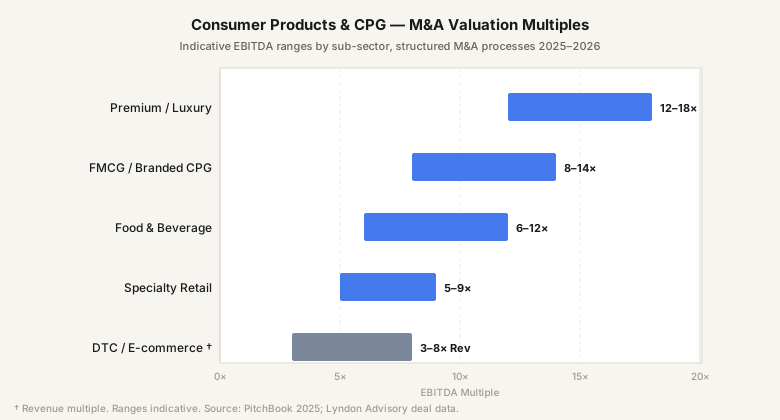
Consumer M&A valuations vary significantly by sub-sector, business model, and buyer type. The ranges below reflect completed precedent transactions in structured M&A processes globally:
| Sub-Sector | EBITDA Multiple | Key Drivers |
|---|---|---|
| Premium / Luxury Consumer | 12–18× | Brand defensibility, loyal repeat purchasers, premium pricing power |
| FMCG / Branded CPG | 8–14× | Distribution breadth, margin quality, category leadership |
| Food & Beverage | 6–12× | Channel mix, ingredient supply control, brand heritage |
| Specialty Retail | 5–9× | Store network quality, private label penetration, lease profile |
| DTC / E-commerce | 3–8× revenue | CAC efficiency, repeat rate, platform concentration |
According to PitchBook’s 2025 Consumer & Retail M&A Report, median EBITDA multiples for branded consumer businesses in competitive auction processes have held broadly stable at 9–11× despite macro headwinds, with top-quartile assets continuing to clear 14× when multiple strategic and financial buyers compete. The bifurcation between high-quality branded assets and commodity businesses has widened — buyers are paying selectively and aggressively for the former.
Enterprise value calculation in consumer M&A also requires attention to working capital normalisation, inventory valuation methodology, and the treatment of brand-related intangibles. For businesses with significant seasonal inventory cycles, agreeing the working capital target and completion accounts mechanism before signing is critical to avoiding post-signing disputes.
Key Deal Considerations
EBITDA normalisation. Consumer businesses present more EBITDA adjustments than most sectors. Standard items include: founder compensation above market rate for a hired CEO, one-time costs (brand relaunches, warehouse moves, system implementations), non-recurring promotional expenditure, and related-party transactions. Working with an advisor and an independent accounting firm to prepare a vendor due diligence report before going to market — rather than leaving buyers to run their own diligence — reduces re-trading risk and accelerates closing.
Brand valuation. For premium and luxury consumer assets, brand value often represents the majority of enterprise value but requires specialist valuation methodology. Relief-from-royalty and excess earnings approaches are both used; buyers will have their own views. Having an independent brand valuation prepared pre-process gives the seller an anchor and supports the price narrative in the CIM.
Distributor concentration and channel transition risk. A business heavily dependent on a single distributor — particularly if the distribution relationship is personal to the founder — requires careful structuring. Buyers will stress-test what happens to the distribution relationship post-acquisition. Building multi-channel distribution and reducing key-person dependency in distribution relationships before a process begins is high-ROI preparation work.
Earnout provisions. Consumer M&A transactions in the $10–50M enterprise value range frequently include earnout components, particularly where significant brand growth potential exists but is not yet reflected in trailing EBITDA. Earnouts in consumer deals are often tied to brand KPIs (repeat purchase rates, NPS, social audience growth) rather than purely financial metrics. Understanding the earnout mechanics — and negotiating caps, floor calculations, and measurement methodologies carefully — is material to total deal economics.
How to Prepare a Consumer Business for Sale
The decisions founders make 12–24 months before a sale process are more valuable than anything that happens during the process itself. The highest-impact preparation steps for consumer businesses:
- Build multi-channel distribution. Reduce dependence on any single retailer, marketplace, or distributor below 40% of revenue where possible.
- Document brand metrics. Compile repeat purchase rates, Net Promoter Score, customer lifetime value, and social media engagement metrics into a data room-ready format.
- Clean up EBITDA. Begin separating personal expenses, discretionary owner benefits, and one-time costs from operating EBITDA — and document the adjustments.
- Protect IP. Ensure trademarks are registered in every market where the brand sells or could sell. IP gaps create diligence risk and buyer leverage.
- Reduce key-person dependency. Buyers pay a control premium but discount heavily for founder dependency. Building a second tier of management is high-ROI pre-sale preparation.
Cross-Border Consumer M&A: APAC and US Dynamics
Consumer M&A in Asia Pacific and the United States shares the same fundamentals but differs in buyer behaviour, regulatory process, and deal mechanics.
According to McKinsey & Company’s 2025 Global M&A Trends Report, consumer and retail was among the top sectors for cross-border deal activity in 2025, driven by Asian strategics acquiring Western brands and US PE platforms pursuing APAC consumer assets with proven omnichannel distribution. In the United States, consumer cross-border M&A transactions are driven by APAC brands seeking North American distribution scale, and US brands seeking to acquire APAC consumer platforms with regional growth stories. The US consumer M&A market is the deepest and most liquid globally — strategic buyer competition is more intense, and PE roll-up activity is sophisticated and well-capitalised. Founders selling US consumer businesses benefit from a larger buyer universe but must navigate longer diligence timelines and more rigorous representations and warranty insurance requirements.
In Asia Pacific, consumer M&A is shaped by the region’s distribution fragmentation, the cultural importance of brand heritage in premium positioning, and the speed at which social commerce has disrupted offline retail. Japanese and Korean strategic buyers are particularly active and bring long hold periods and patient capital. Southeast Asian family conglomerates consolidate food and distribution platforms. Australian consumer businesses attract both domestic PE and cross-border Asian strategic interest, particularly in premium food, nutrition, and supplements.
“The consumer M&A buyer universe has genuinely globalised. A premium food brand in Australia is on the acquisition radar of Japanese trading houses, US PE-backed platforms, and European consumer groups simultaneously. Founders who only speak to domestic buyers are leaving serious value on the table.”
— Daniel Bae, Founder and CEO of Lyndon Advisory
Lyndon Advisory provides consumer M&A advisory with active buyer coverage across Asia Pacific and the United States — running structured auction processes that engage domestic, regional, and cross-border buyers to create genuine competitive tension.
Choosing a Consumer M&A Advisor
The right consumer M&A advisor brings three things: sector-specific knowledge of who is actively acquiring in your category, a buyer network that spans strategic and financial buyers across relevant geographies, and a process structure that creates competitive tension without burning relationships.
In a structured auction process, an experienced consumer advisor prepares a compelling investment teaser and CIM, approaches a curated buyer list that spans global strategics, Asian buyers, PE roll-up platforms, and family offices, manages the indication of interest and letter of intent stage to maximise competitive tension, and leads due diligence and negotiation through to signing and closing.
Fee structure is also material. Advisors who charge retainers — regardless of whether a deal closes — have misaligned incentives. A success-fee-only structure aligns the advisor’s interests directly with the seller’s outcome.
Choose the Right Consumer Products M&A Advisory Path
| Situation | What Lyndon should understand first | Best next step |
|---|---|---|
| You are evaluating whether to sell a consumer products, CPG, FMCG, beauty, or specialty food business | Revenue, EBITDA, category, channel mix, gross margin, brand ownership, customer concentration, and buyer universe | Submit a consumer products valuation inquiry |
| A CPG group, PE platform, distributor, family office, or overseas strategic has approached | Buyer motive, offer logic, brand/IP disclosure risk, channel concentration, exclusivity pressure, and alternative buyer universe | Review the buyer approach |
| You are 6-18 months away from a possible sale | Brand metrics, channel diversification, trademark coverage, inventory quality, management depth, and data-room gaps | Check consumer exit readiness |
| You are comparing consumer M&A advisors | Retainer exposure, fee cap, strategic buyer reach, APAC/US buyer access, tail period, and expected net proceeds | Compare advisory economics |
| You are an investor looking for consumer or CPG targets | Category thesis, target geography, EBITDA range, channel preference, brand profile, and control preference | Submit acquisition criteria |
Considering a sale of your consumer products or CPG business? Lyndon Advisory advises consumer brands and CPG companies on sell-side transactions globally, with buyer coverage across Asia Pacific and the United States. Our fee is a 2% success fee capped at US$300,000 — no retainer, no monthly fees, no expense recharges. Submit a confidential valuation inquiry to understand what your business could be worth and who would buy it.
Market Guides
About the Author

Daniel Bae
Co-founder & CEO, Lyndon Advisory
Daniel is an investment banker with 15+ years of experience in M&A, having advised on deals worth over US$30 billion. His career spans Citi, Moelis, Nomura, and ANZ across London, Hong Kong, and Sydney. He holds a combined Commerce/Law degree from the University of New South Wales. Daniel founded Lyndon Advisory to solve the pain points in M&A, enabling bankers to focus on what matters most — delivering trusted advice to clients.
About Lyndon Advisory
Lyndon Advisory is an M&A advisory firm built for Asia Pacific. We help business owners sell their companies and investors make strategic acquisitions with senior-led execution, disciplined process management, and structured buyer research. For owners, the first step is a confidential review of valuation range, likely buyer universe, and whether a structured sell-side process is justified.
Request a confidential seller reviewTopic cluster