Lyndon Advisory is a specialist food and beverage M&A advisor for FMCG brands, restaurant chains, food manufacturers, and branded beverage businesses in Asia Pacific and the United States. We run structured sell-side M&A processes — no retainer, no monthly fee, 2% success fee capped at US$300,000. Submit a confidential F&B valuation inquiry to understand what your business is worth and who would buy it.
For the complete preparation and closing roadmap, read Lyndon Advisory’s guide to selling a business. For downloadable valuation ranges by F&B sub-sector, see the Consumer, Food & Retail M&A Benchmark 2026. For a step-by-step F&B sale process guide, see How to Sell a Food & Beverage Business.
Food & Beverage M&A Advisor: Where Owners Should Start
The right advisory choice depends on who would buy your business. A small single-site restaurant, cafe, or local hospitality business may be best served by a local broker who knows nearby operators. A branded food, beverage, FMCG, ingredients, franchise, or multi-site business with regional buyer logic needs a structured M&A process that can reach strategic acquirers, private equity, family offices, and cross-border buyers — Japanese food corporations, Korean conglomerates, ASEAN strategics — without losing confidentiality.
That distinction matters in Singapore, Malaysia, Australia, and Hong Kong, where the best buyer for a food or beverage company is often not the closest buyer. Japanese food groups, Korean strategics, regional ASEAN conglomerates, Australian consolidators, Hong Kong family offices, and consumer-focused PE platforms can all underwrite the same asset differently.
Food and beverage is one of the most active and complex sectors for M&A advisory globally. The buyer universe spans global food multinationals, regional strategics, Japanese and Korean trading houses, and private equity roll-up platforms — and the valuation dynamics are as varied as the sub-sectors themselves. A premium craft beverage brand may command 12x EBITDA; a commodity food distributor in the same revenue range might transact at 5x.
For F&B business owners considering a sale, the advisory decision is consequential. An advisor who understands how buyers underwrite brand equity, commodity exposure, food safety compliance, and franchise structures will run a materially different process than one who doesn’t. This guide covers the advisory landscape, buyer universe, valuation benchmarks by sub-sector, and the key deal considerations that shape F&B transactions.
For a step-by-step guide to preparing and running an F&B sale process, see How to Sell a Food & Beverage Business. For citation-ready ranges across food, beverage, CPG, beauty, and retail, use Lyndon Advisory’s Consumer, Food & Retail M&A Benchmark 2026.
Quick Fit: Local Broker or Regional F&B M&A Advisor?
| Situation | Likely best route | Why |
|---|---|---|
| Single-site restaurant, cafe, or bar with owner-led operations | Local broker or local accountant | Buyer is probably another local operator; a cross-border process may add cost without expanding value |
| Multi-site restaurant, QSR, or franchise group | Regional M&A advisor | Buyers may include domestic consolidators, PE platforms, and regional franchise operators |
| Branded food, beverage, FMCG, or health product business | Sector-focused M&A advisor | Brand, channel mix, and export potential drive buyer appetite and valuation |
| Ingredients, food manufacturing, or distribution business | M&A advisor with strategic-buyer reach | Buyer universe may include supply-chain strategics, export buyers, and PE roll-up platforms |
| Small local F&B business below institutional buyer scale | Local route first | Lyndon manually reviews inquiries, but very small local situations are often better handled locally |
For country-specific context, see our guides to selling an F&B business in Australia, consumer and retail M&A in Singapore, Malaysia consumer and retail M&A, and Hong Kong consumer and retail M&A.
What Makes F&B M&A Different
Food and beverage transactions carry a distinct set of risks and considerations that set them apart from general M&A:
Brand transferability. In most sectors, a business can be valued on its revenue and earnings. In F&B, buyers pay a premium for the brand — but only if the brand survives without the founder. A consumer brand where loyal customers are loyal to a person rather than a product faces significant valuation discounts. Buyers probe this through consumer surveys, repeat purchase data, and brand equity analysis.
Regulatory and food safety compliance. Food safety certifications (FSSC 22000, BRC, HACCP, organic, halal, kosher) are increasingly prerequisites for acquirers with institutional supply chains. Any recall history, regulatory action, or certification lapse becomes a material due diligence issue. Buyers price this risk explicitly — a clean regulatory record commands a premium; an undisclosed issue found in diligence can collapse a deal.
Commodity price exposure. Most F&B businesses are exposed to input cost volatility — grain, dairy, meat, cocoa, coffee, packaging. Buyers assess whether the business has pricing power to pass through cost increases, contractual protections with suppliers, or hedging mechanisms. A business with compressed margins from unhedged commodity exposure and no demonstrated pricing power will face multiple compression at negotiation.
Intellectual property ownership. Recipes, trademarks, packaging designs, and proprietary formulations must be owned by the entity being sold — not the founder personally, a related family trust, or an informal arrangement. IP that hasn’t been formally assigned to the company requires remediation before a sale process, which takes time and legal cost.
Owner dependence. F&B businesses built around a founder chef, a family brand, or a personal relationship with key accounts are structurally harder to sell at premium multiples. Buyers model what happens to revenue when the founder exits, and price that risk into their offer.
The F&B Sub-Sector Buyer Universe
Different sub-sectors attract different buyer profiles, and understanding this shapes how an advisor approaches the market.
Packaged Food and FMCG Brands
The most liquid sub-sector for M&A. Global strategics — Nestlé, Unilever, Kraft Heinz, Danone, Mars — run active corporate development programmes targeting brands with regional or global growth potential. Regional food groups (CP Group, CJ CheilJedang, Universal Robina, George Weston, Bega Cheese) seek category and geography expansion. Private equity firms back roll-up platforms in categories like health food, organic, functional nutrition, and premium snacking.
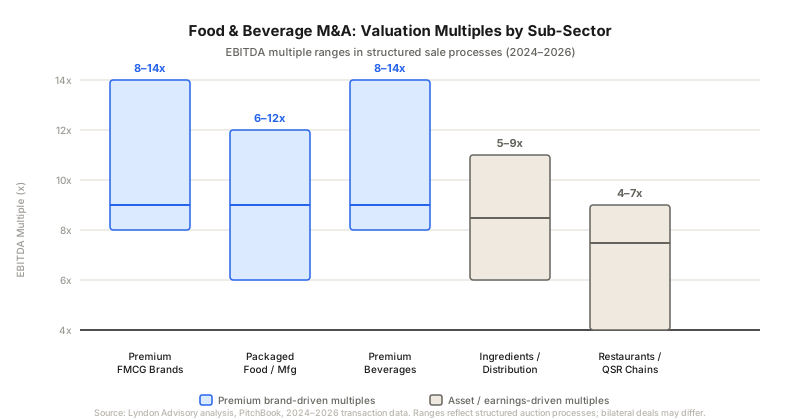
Valuation range: 6–14x EBITDA for branded businesses with national distribution, clean margins, and documented repeat purchase rates. The upper end is reserved for brands with international expansion potential and defensible market positions.
Beverages (Alcoholic and Non-Alcoholic)
Premium and craft beverages — specialty coffee, functional beverages, craft spirits, artisan juice — attract the broadest buyer universe and the highest multiples. Large beverage groups (Suntory, Asahi, FEMSA, Constellation Brands, AB InBev’s venture arm) pursue premium positioning through acquisition. L Catterton, Swander Pace Capital, and other consumer-focused PE funds are active in functional and premium beverage.
Valuation range: 8–14x EBITDA for premium positioned brands with strong DTC or on-premise channels; lower for commodity beverage manufacturers without brand differentiation.
Restaurants and QSR Chains
Restaurant M&A is driven by a different logic: buyers are acquiring store networks, proven operating systems, and brand recognition at a geographic scale — not just earnings. Franchise models attract strategic acquirers seeking to expand into new markets without capital intensity. PE buyers focus on multi-unit operators with proven unit economics and a pipeline for new site development.
According to Nation’s Restaurant News, multi-unit restaurant chain transactions in the US and APAC accelerated in 2025, with PE-backed consolidation activity particularly active in QSR and fast-casual categories.
Valuation range: 4–7x EBITDA for multi-unit chains with positive same-store sales, strong lease portfolios, and proven franchisee economics. Distressed or single-format brick-and-mortar operators with lease concentration trade lower.
Ingredients, Food Manufacturing, and Distribution
Less brand-driven, more earnings-driven. Buyers are typically strategic buyers seeking supply chain integration, manufacturing capacity, or exclusive distribution rights. Proprietary formulations, certifications, and long-term supply contracts with anchor customers drive the most value. Pure commodity processors with no IP command the lowest multiples in the sector.
Valuation range: 5–9x EBITDA, with the upper end reserved for businesses with proprietary processes, export capability, and long-term anchor customer contracts.
Key Deal Considerations in F&B M&A
EBITDA Normalisation
F&B businesses — particularly founder-led or family-owned operators — typically carry a range of above-market owner salaries, personal expenses, and related-party transactions that must be normalised before a buyer will underwrite earnings. A quality of earnings analysis conducted by the seller before going to market establishes a credible normalised EBITDA figure and reduces the risk of a buyer renegotiating price mid-process after finding adjustments in diligence.
A well-prepared normalisation schedule typically adds 15–30% to headline EBITDA for owner-operated F&B businesses — a meaningful impact on valuation at standard sector multiples.
Franchise and Distribution Agreements
Buyers acquire the right to the revenue stream — not just the brand. Distribution contracts with major retailers or foodservice operators must be assignable or re-novatable on a change of control. Franchise agreements must define what happens to the network on a sale. Undocumented informal arrangements — a handshake agreement with a major distributor, a de facto exclusivity arrangement with a retail chain — are material risks that surface in due diligence and compress multiples.
Earn-Out Structures
F&B transactions frequently include earnout provisions tied to brand milestones — maintaining retail distribution, achieving new product launch targets, or sustaining repeat purchase rates post-completion. Earn-outs are more common in F&B than in most sectors because buyers find it difficult to separate brand equity from founder involvement at the time of sale. Sellers should negotiate earn-out structures with achievable milestones and clear measurement mechanics, and resist earn-outs tied to metrics they cannot directly control post-completion.
Cross-Border Considerations
The most active cross-border buyers in global F&B M&A are Japanese and Korean food corporations, which systematically acquire premium food and beverage brands in North America, Australia, Southeast Asia, and Europe as a growth strategy. According to Nikkei Asia, Japanese food companies completed more than 40 overseas acquisitions in 2024, with premium food brands in Australia and the US among the most sought-after targets.
For F&B sellers in Singapore, Malaysia, Australia, Hong Kong, the United States, or Europe, this cross-border buyer dimension is often underutilised. An advisor with APAC buyer relationships — particularly into Japanese and Korean corporate development — can run a more competitive process and achieve better pricing than one limited to domestic buyers.
Lyndon Advisory provides F&B sell-side advisory across Asia Pacific and the United States.
“The F&B buyer universe is genuinely global — a premium Australian food brand should be marketed to Japanese food corporations and US PE-backed consolidators simultaneously. The best outcomes come from advisors who can run a cross-border process without limiting the buyer list to their domestic network.”
— Daniel Bae, Founder and CEO of Lyndon Advisory, who has advised on over US$30 billion in transactions
Choosing the Right F&B M&A Advisor
Sector Experience vs General M&A Credentials
General M&A credentials are necessary but not sufficient. An advisor who has sold technology companies and professional services firms will not intuitively know how to position a branded food business to a Japanese trading house, or how to structure a franchisee quality presentation for a PE buyer underwriting restaurant unit economics. Ask specifically for comparable F&B transactions — sub-sector, deal size, buyer profile.
Buyer Network Depth
The quality of an auction process is determined by who is in the room. An advisor with direct relationships with corporate development at regional food groups, investment committees at consumer PE funds, and business development teams at Japanese food corporations will generate more competitive tension — and better pricing — than one who contacts buyers by cold email. Ask your advisor to name the decision-makers they know at the top ten likely buyers for your business.
Fee Structure
Most boutique M&A advisors in the US and APAC charge 3–6% success fee plus a monthly retainer of $10,000–$25,000. On a $15 million F&B transaction, that is $450,000–$900,000 plus $120,000–$300,000 in retainers — a significant cost for a founder who paid nothing upfront to build the business.
Lyndon Advisory charges a success fee of 2% of enterprise value, capped at US$300,000, with no retainer and no expense recharges. On a $15 million transaction, that is $300,000 — roughly half the industry standard — with no upfront financial commitment.
Process Rigour
A structured sale process — blind teaser, NDA, CIM, management presentations, indication of interest, letter of intent, exclusivity, and due diligence — creates competitive tension and protects confidentiality. Advisors who shortcut this process (going directly to one buyer, skipping the CIM, running informal negotiations) typically achieve lower prices and carry higher execution risk.
Choose the Right Food & Beverage M&A Advisory Path
| Situation | What Lyndon should understand first | Best next step |
|---|---|---|
| You are evaluating whether to sell a food, beverage, ingredients, restaurant, or F&B platform | Revenue, EBITDA, channel mix, brand ownership, food safety records, supplier concentration, and buyer universe | Submit an F&B valuation inquiry |
| A strategic food group, PE platform, franchise buyer, distributor, or overseas acquirer has approached | Buyer motive, offer logic, brand/IP disclosure risk, exclusivity pressure, and alternative buyer universe | Review the buyer approach |
| You are 6-18 months away from a possible sale | Food safety documentation, supplier contracts, margin normalisation, brand metrics, management depth, and data-room gaps | Check F&B exit readiness |
| You are comparing F&B M&A advisors | Retainer exposure, fee cap, consumer buyer reach, Japanese or US buyer access, tail period, and expected net proceeds | Compare advisory economics |
| You are an investor looking for F&B targets | Category thesis, target geography, EBITDA range, channel preference, control preference, and food safety requirements | Submit acquisition criteria |
Thinking about selling your food or beverage business? Lyndon Advisory advises F&B owners on sell-side M&A across Asia Pacific and the United States — success fee only, 2% success fee capped at US$300,000. Submit a confidential valuation inquiry to understand what your business is worth, whether Lyndon is the right fit, and who would buy it.
Related Guides
For the broader framework behind this topic, see Lyndon Advisory’s guide to selling a business.
About the Author

Daniel Bae
Co-founder & CEO, Lyndon Advisory
Daniel is an investment banker with 15+ years of experience in M&A, having advised on deals worth over US$30 billion. His career spans Citi, Moelis, Nomura, and ANZ across London, Hong Kong, and Sydney. He holds a combined Commerce/Law degree from the University of New South Wales. Daniel founded Lyndon Advisory to solve the pain points in M&A, enabling bankers to focus on what matters most — delivering trusted advice to clients.
About Lyndon Advisory
Lyndon Advisory is an M&A advisory firm built for Asia Pacific. We help business owners sell their companies and investors make strategic acquisitions with senior-led execution, disciplined process management, and structured buyer research. For owners, the first step is a confidential review of valuation range, likely buyer universe, and whether a structured sell-side process is justified.
Request a confidential seller reviewTopic cluster